
|
|
Driving in winter
|

Winter driving tips
Winter weather conditions can make roads difficult to navigate and particularly dangerous. To drive safely, you need to adapt your driving style and take a number of precautions, such as:
- driving slowly,
- increasing your following distance,
- aiming for a ‘smooth’ driving style by avoiding sudden acceleration or braking.


You must also pay particular attention to any traffic restrictions and diversions in place, ensure the safety of workers on roadworks, and give way to snow-clearing and gritting vehicles.
To improve road user safety by reducing the specific risks associated with driving on snow-covered or icy roads, winter equipment is compulsory in certain municipalities within mountain ranges (the Alps, Corsica, the Massif Central, the Jura Mountains, the Pyrenees and the Vosges). This requirement applies in 34 departments.
From 1 November 2024, only tyres marked ‘3PMSF’ (3 Peak Mountain Snow Flake) will be accepted as an alternative to snow chains. The purchase and use of ‘M+S’ (Mud + Snow) snow tyres will still be permitted, but in such cases, drivers must also carry snow chains to drive in mountainous areas.
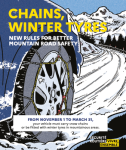
Under the Act on the Modernisation, Development and Protection of Mountain Areas, known as Mountain Act II, Decree No. 2020-1264 of 16 October 2020 (Format pdf - 142.3 kb - 19/11/2026) makes it compulsory every year, from 1 November to 31 March, light vehicles, commercial vehicles, heavy goods vehicles, coaches, buses and motorhomes must be fitted with winter tyres on all four wheels, or anti-skid devices (metal or fabric snow chains on at least two drive wheels).
New road signs will indicate the start of a zone where such equipment is compulsory. In the absence of snow or black ice, removable devices – snow chains or snow socks – must be kept on board the vehicle.
